Wednesday, 28 May 2014

Caring Care Homes : What to look for

Caring Care Homes: What to look for

Looking after our wellbeing is important at all stages of our lives & it doesn't stop when one goes into a care home/sheltered accommodation. In fact it becomes even more important to look after one's wellbeing so that depression & social isolation are kept at bay.

If you are looking for a Care Home or Sheltered Accommodation for yourself or most likely for an elderly loved family member or friend, then there can be bewildering advice out there as to what to look for in order to get the best place.


I have had experience of working in numerous care homes throughout Norfolk, England, during my long teaching career. I have taught the carers & management teams. Through the 'EXTEND' organisation I also did mobility classes with residents. Towards the end of my commitments with these projects I became quite able to see by just stepping inside the building as to whether it was well managed & a “happy” home.


Well, what does one look for when searching out a care home? It may be worth remembering that this search may be carried out during an emotional/upsetting time for all concerned. The signs of a well cared-for establishments usually indicates that they are paying attention to details & so will pay attention to their residents. Well, with such a bewildering care home facilities & specialism what does one look for? You can, of course, check out the care homes' status/reports on the Care Quality Commission's (CQC) website. 


Well cared-for establishments which pay attention to details are most likely to be those which pay attention to their residents, so it is also       worth keeping an eye open for the following:-


*If there is a strong smell of urine (or worse!) then avoid. It shows that the staff are under pressure & not able to deal with this very necessary care with any degree of satisfaction.


*Are the residents actively encouraged to take part in activities offered -  whether it be crafts to maintain dexterity, social events to maintain contacts or talks to challenge the grey matter?


*
Is there a weekly diary of planned activities or outings? Are these actively carried out or are they there just to impress the inspection team?


*Do the care homes invite the community into the homes? For example, one of my regular massage clients lives in a home run by a housing association & they have a close link with a nearby local school. Here the children visit the home regularly &  do story books/crafts with the residents. My client has proudly shown me these & says she very much enjoys these sessions. The children also sing for the residents. More importantly, each resident (who wants this) is 'assigned' to an  individual named child. Does the care home have an annual fĂȘte or coffee mornings to raise money for extras such as outings for the residents? Is there a committee to organise these 'extras'? Are the residents involved in having a say in how the money raised should be spent on?


*Are the residents encouraged to sit outside? Is there appropriate & comfortable seating with some shade provided? Most people feel good when the sun is shining & Vitamin D, acquired by exposure to the sun, is crucial for our wellbeing. Are the seasons brought indoors in some way? Are there, for example, cut flowers in vases or living plants. These don't have to cost much and can be provided using planters, window boxes or grow bags. Even cardboard egg boxes can be used. Simple things such as a very small pot of herbs on the dining table can enhance the senses & also be a conversation point. Vases filled with autumn colours don't cost anything except the time/thought.


*Are there large pictures reflecting the seasons & the outside world or there just poor copies of masterpieces such as Constable's 'Haywain'?


*Do the staff interact with the residents in a meaningful way or are they just acting robotically & fulfilling their job description? How do the staff address the clients? Are they using their first names with the resident's permission or are they using inappropriate patronising names? Do you get the feeling that the carers are seeing the residents as just another 'service user' (horrible term!) & just carrying out tasks according to the residents' perceived/assessed "support need".


*Are visitors encouraged to stay for drinks/meals? Are there any visitors' facilities such as a corner to make drinks? Are there options at meal times with special diets (such as low-fat) catered for without a fuss? Do the staff remember who has a special diet? Is there some way of identifying those needing special diets? Do residents get to pre-select their meals or is everyone served the same thing? Are residents given help with feeding? Are there enough staff to provide help with feeding? Does the home take part in a 'feeding companionship' programme where the trained volunteers help to feed anyone needing help?

*Does the home arrange outings? It could be just to the supermarket or free museums visits or just somewhere nice to enjoy the countryside – none of these cost much! A visit could become the highlight of many of the residents' week/month.


*Does the care home have a 'memory box/table' that display items from the past to promote memory & conversations. These can be easily acquired very cheaply from charity shops & could include old magazines, kitchen memorabilia, old pictures. These should be regularly changed to encourage & stimulate conversations & interest.  Many library services also have memory boxes on loan.Does the mobile library service visit? Are there any interesting books/magazines for the residents to read? Are these in good condition or are they dated & tatty?


*Are the bedrooms & other rooms in good decorative order? Are personal items such as family photos, 'treasures' or small pieces of personal furniture allowed? All these things will help the residents to maintain a contact with their past.

*Is the home in contact with charities for befriending services? How is social isolation avoided? 

*How are complaints handled by the manager? Is there a formal procedure? Is there a suggestion box/comment book?

Whatever you choose make sure that you regularly check suitability as your friend's, family member's or your care needs will change over time.

Good luck in your search.


Many thanks to Eddie, from my IT class, for proof-reading this & also adding some valuable comments.


Wednesday, 7 May 2014

Being Mindful at 2 years old

Recently I had the honour & privilege of looking after a 2 year old. Her name's Molly. During our time together I learnt a lot about Mindfulness from her. The world of a 2 year old comprises of moments and how to take part and enjoy those moments occupies them totally as the picture below shows!

watching noisy lorries can be relaxing too!

Young Molly's actions embrace everything that I appreciate & understand as 'Mindfulness' . In its essence it includes taking note of what's around you, enjoying the simple things, standing & staring for the sake of it and appreciating the simple things in life. You don't need money for Mindfulness just the willingness to take the time out & note things.


enjoying the journey rather than rushing to get there!

Also, Mindfulness for me means enjoying the moment to its full & taking joy in the present rather than letting the past invade our thoughts & also not thinking too far ahead! To me it also means being curious & catching sight of everything around me & finding the beauty in everyday things & savouring the task at hand whatever they may be.

"Today is a gift, that is why it is called the Present".


exploring the equipment before baking
enoying the sensation of the water


appreciating things even when they don't make sense to you

taking opportunity to relax wherever you are

taking time out to stand & stare & noticing things 

So take time out & enjoy the sensations, sights & sounds around you like Molly does. You may like them!

Tuesday, 22 April 2014

Stress & 2 ways to manage it

Stressed? Me, never!!” How often have I heard those words from ex-colleagues, family & friends who are clearly stressed as shown by their very physical presentation. Symptoms can include frown marks, hunched shoulders or tense body posture. So, what actually is stress? Stress is looked upon as something more than a person can normally cope with; this could be in the form of emotional, physical or psychological demands. These extra pressures are known as 'stressors'. What may be a stressor for one person may not be for another. For example, I'd find moving house (or the very thought) very stressful whilst I have a friend to whom it is exciting & new & very much to be looked forward to. So, what happens when our bodies are under stress? Most stressed bodies will experience high blood pressure, great muscle tension, unsteady & fast heart beat, quick & inefficient breathing & a busy & easily distracted mind.

The good news is that it is easy to achieve a relaxed body in order to self-manage your stress level. A relaxed body will help you to cope so much better with the demands made by everyday living. One of the ways is a technique called 'palming', shown below. This technique includes taking a few minutes out every day to totally relax the eyes which will help to calm the rest of your body and mind. Firstly, shake your hands as if you are air drying them. Then warm up your hands by rubbing them vigorously until they feel nice & warm. The next step is to cup them gently and place them firmly over your eyes for a few minutes. Try to steady your breathing and concentrate on that. Finally, slowly take your hands away and gently open your eyes. You should feel refreshed. You may find that taking a few minutes out of your daily routine to relax is vital to you functioning at your optimum.


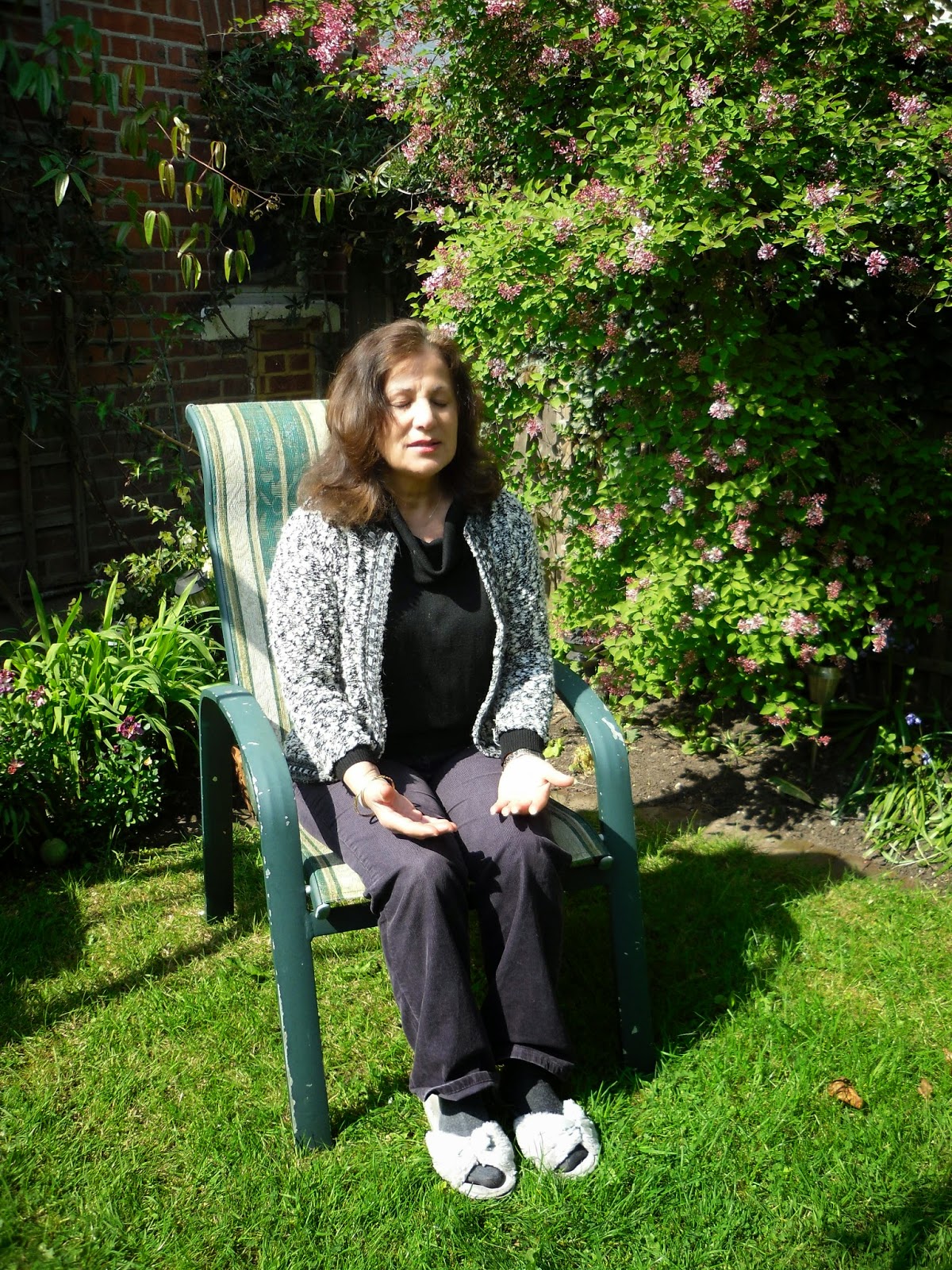
The other effective technique is to deliberately concentrate on your breathing (pictured below). It can be done anywhere! Wherever you are then it is important to find a space where you won't be disturbed. Switch off the phone, turn on some music if that would help. To do this, sit in a comfortable position with your arms on your lap & palms facing upwards. Then gently close your eyes and breathe deeply and slowly. Try to continue for 5 – 10minutes and then slowly open your eyes and carry on with your routine. It is best to try not to push away any thoughts but to acknowledge them & then carry on focusing on your breathing. Good luck & be calm & relaxed.

Outside is a lovely space to do this technique


Find a space where you won't be disturbed

Monday, 17 March 2014

MS & Massage

I recently had the privilege of working at the MS Therapy Centre in Norwich, NR6 6BB. The photos below shows the hand massages I gave the volunteers & some of their families:-


Getting ready for my day at the MS Centre


One of their wonderful volunteers having a hand massage

Multiple Sclerosis (MS) is a neurological condition & the diagram below clearly shows the damage that occurs in the myelin which is a protective sheath surrounding the nerve fibres of the Central Nervous System (CNS):-


As a result messages get scrambled & as there are no clear pathways this may affects movements. It can also result in poor mobility, pain & impaired cognitive abilities.


Women's Health Forum

One for the ladies! I'm so delighted to say that I've been invited to do an interactive talk & offer mini treatments at this event focusing on women's health this coming Sunday. 

Please come along & support. Venue in central Norwich, NR2 1SF, opposite the delightful Chapelfield Park.


Wednesday, 12 March 2014

5 Ways to Take Care of Your Back

The most common area of the body to suffer from stress & strain is the back. It will affect about four in five people at some point in their lifetime. Back pain can occur at any age & sometimes without any warning. It is commonest between the ages of 35 and 65. Back pain is the second most frequently reported reason for visiting a doctor, and after the common cold, is the next leading reason for missed workdays for people under 45. It is also a major cause of work related sickness absence in the UK and can affect every type of business. Not only does it drain the economy but it also has real human cost. As those that suffer from it will tell you that severe nagging back pain is very difficult to ignore. It can be all consuming. I'm often asked if anything can be done about it & it is a difficult problem to cope with but the following may help:-

1. STAY MOBILE - It is really crucible that you stay mobile even if you don't want to! This will help your muscles to strengthen & support your back. This can be done by v gentle walking (having someone to do with this may help or joining a local walking group) or swimming at your own gentle pace. Water will support your back whilst you strengthen the muscles around that area by gently kicking & circling your legs.

2. BACK EXERCISES - are always recommended by the therapists & gentle exercises may be helpful to strengthen the muscles. Also, regular sessions of gentle back massage may help you:


3. 'MIND OVER BODY' - try some gentle relaxation techniques such as those developed by Mindfulness  This was recently recommended by the Speaker of the Houses of Parliament so it must be good for you!

4. STRETCHING - If possible, do this before you get out of bed in the morning. This may help you to be not so stiff. Also, do gentle stretching exercises throughout the day whenever you feel yourself stiffening up. This is really important to do just before going to bed.

5. CALM & POSITIVE - this is easier said than done! I know this from experience. When you are in pain it seems to dominate your life & every move is an gigantic effort. However, if you can try to remain in calm state & have some positive thoughts such as: 'I'm going to get better', this will aid your recovery. Research has shown that positive (glass half full type!) recover much better from medical episodes.

Wednesday, 12 February 2014

Massage sessions de-mystified!


For those who have never had a massage before I'm often asked what its like! Well, that's a difficult question to answer as everyone responds differently to a session & each experience will be an unique one depending on what they are having, the experience of the therapist & what state the person treating is in. I'm also often asked do I have to undress completely? Well, the answer again is its up to you! Most clients undress down to their underwear but you can have all your clothes on & have what's called a 'seated clothed massage' as can be seen from the picture below:- 

Clothed seated massage by Bibi

Also, you don’t have to lie down on a massage couch if that's difficult for you to do. You can have a massage in almost any position: lying on your side, standing against a wall, on your stomach or on your back. Should a client choose to undress to their underwear then they are covered with towels & these are carefully moved as required to carry out the treatment. 

The other question that I'm often asked is: 'what happens during a session? Well,that depends on what treatment you have come for and the therapist you see! With my own practice there is always a full consultation so that
your medical history and lifestyle can be taken into consideration in the treatment plan. If you have come for a unclothed massage then you get changed in privacy and lie on the couch. I then start the treatment & will ask for feedback from you regarding the strokes & pressure etc. 

At the end we chat about the treatment and your aftercare is outlined. This is written down & given to you as a reminder. Also, I will advise about what you can do in-between treatments to maintain or improve your body’s equilibrium. This may be through gentle stretching exercises which I'll show you or changes to your lifestyle or diet may be discussed.


Upper back massage by Bibi


Shoulder & arm massage by Bibi


Leg massage by Bibi